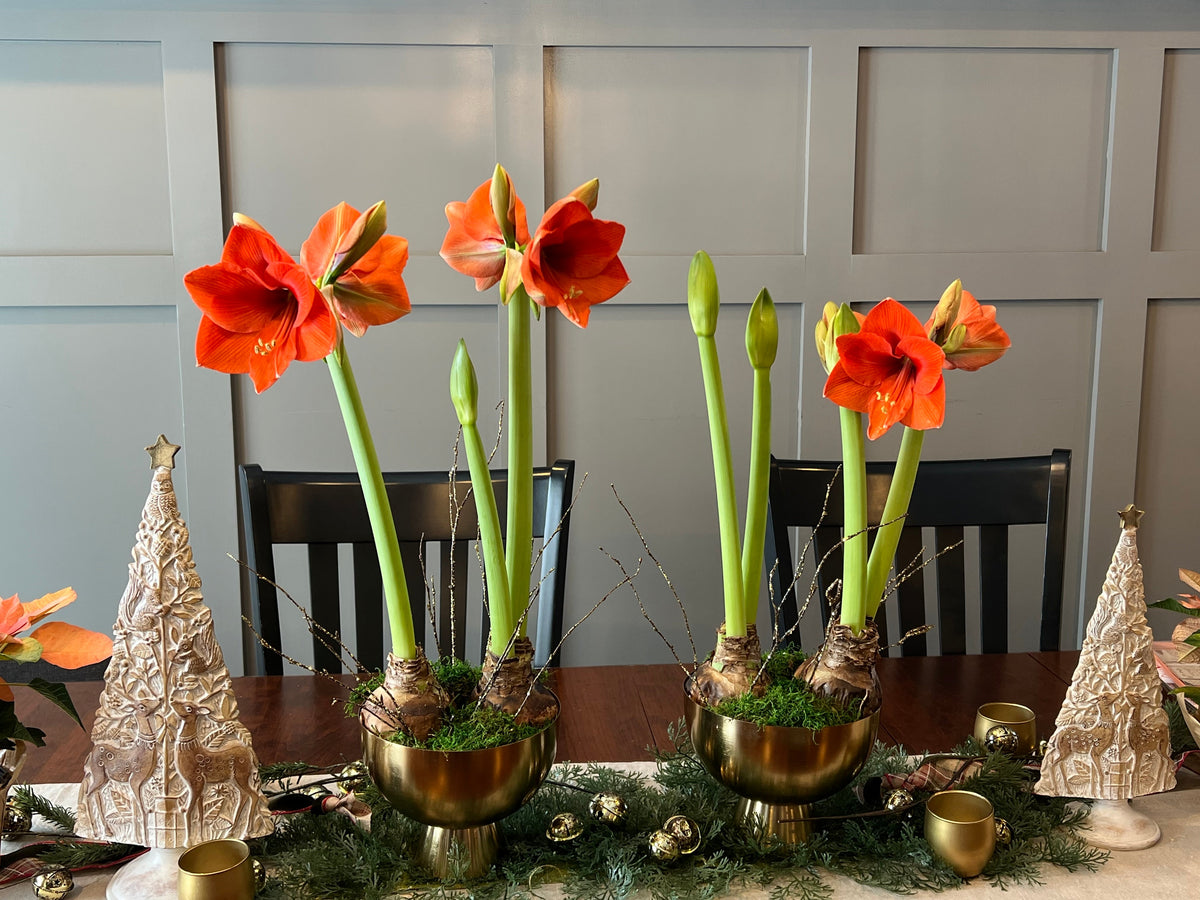
A Pella holiday tradition, one bulb at a time

Every November, boxes of bulbs show up on our workbench in downtown Pella. It’s just after we’ve shipped hundreds of tulip bulbs to our customers and planted our own tulips at home and in the city gardens. These new bulbs come from the same family-owned business we buy our tulip bulbs from, but they’re something different entirely. They don’t look like much: papery, round, a little lumpy. Give one six weeks, though, and it turns into what we call the showstopper of the season.
That’s the magic of an amaryllis, and it’s one of my favorite things to share with our Pella community and the visitors who find us this time of year. Here’s the story of the amaryllis, plus everything you need to know to plant it, care for it, and enjoy it again next year.
From South America to Holland to Pella
The amaryllis we bring home at Christmas started out growing wild in Central and South America and the West Indies, in places ranging from tropical rainforests to dry hillsides and even beaches. With all their experience growing bulbs like tulips, the Dutch saw amaryllis as a natural addition to their work. Through Dutch hybridizing, the blooms grew bigger and the colors more vibrant, and growers even created striped varieties.
Here in Pella, we love carrying on our Dutch traditions, and amaryllis feels right at home in a town that celebrates its Dutch roots every spring with tulips. It’s simply the winter chapter of that story.
How to plant an amaryllis bulb
Choose a pot just a little bigger than the bulb, with a drainage hole. Amaryllis likes to be snug, so leave about an inch of room around the sides.
Fill the pot with good potting soil and settle the bulb in so the top third (or half) peeks out above the soil. Water it once, well, and then let it be. Too much water before you see green growth is the main way to lose a bulb, so go easy until the first shoot appears.
How to care for your amaryllis while it grows

Give it a bright window, away from heat vents and drafty doors. Iowa winters can be tough on houseplants, and amaryllis does best somewhere comfortably warm and steady. We suggest 4 hours of light, this light will provide more energy to the bulb with the potential of more stalks and more blooms.
Once it starts growing, water when the top inch of soil feels dry. Turn the pot every few days so the stalk grows straight instead of leaning toward the light. In about six to eight weeks, you'll have blooms. Move it out of direct sun once it flowers and the blooms will last longer.
How to make your amaryllis bloom again next year
Here's the part most people don't know: your amaryllis doesn't have to be a one-season flower. With a little care, the same bulb can bloom year after year, all indoors.
When the flowers fade, cut the stalk an inch or two above the bulb, but keep the leaves. Those leaves are busy storing energy for next year. Keep the pot in your sunniest window through spring and summer, water it like a houseplant, and feed it with houseplant fertilizer about once a month.
In early fall, stop watering and tuck the pot somewhere cool and dark, like a basement or a closet. Let it rest for about eight to twelve weeks. The leaves will yellow and fade, and that's exactly what you want. When the rest is over, bring it back into the light, water it again, and watch it wake up for another holiday season.
A gift that keeps blooming
An amaryllis is one of my favorite gifts to give. It's a little bit of anticipation wrapped up in a pot. You get to watch it grow, and then it keeps going long after the holidays are over. It's perfect for a teacher, a neighbor, a hostess, or anyone who could use a little something to look forward to this winter.
If you're in Pella this season, stop by Thistles in downtown Pella, right across from Central Park. We'd love to help you pick one out, and we're always happy to answer your amaryllis questions. Can't wait to see you.
Follow along on our socials for more Made for the Season at Thistles.


